


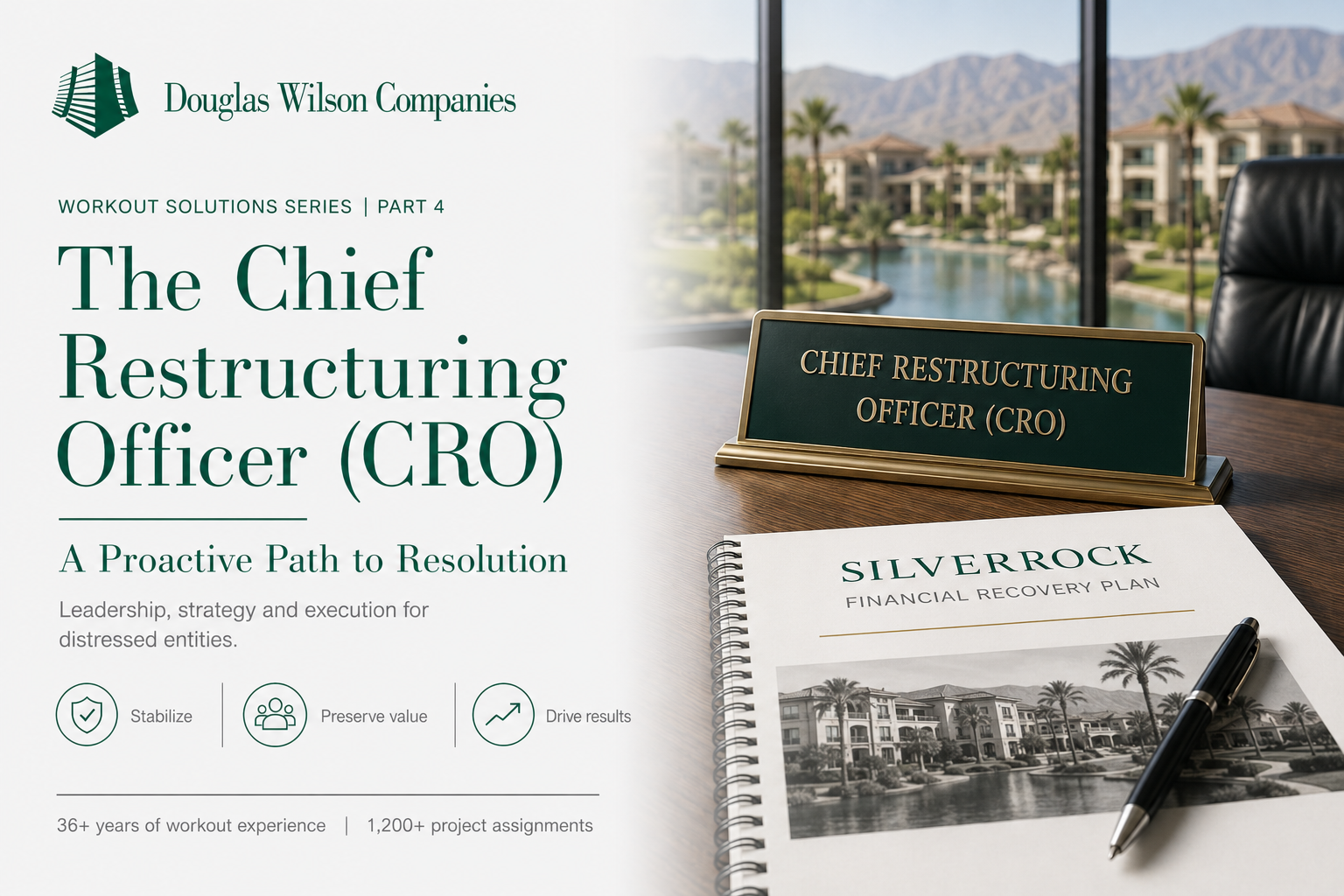
Alternative Workouts Part 4: The Chief Restructuring Officer (CRO)

For a business or ownership entity in distress, there are often many possible paths forward. Some seek Chapter 11 bankruptcy as an option to restructure and reorganize debt. Sometimes there is a court-appointed Receiver who acts as an independent third party to manage the situation and recover value for creditors.
There are many other mechanisms, as well, outlined in parts 1, 2 and 3 of this Alternative Workouts series. In Part 1, Douglas Wilson Companies presented some recent case studies highlighting the Assignment for the Benefit of Creditors, including the recent wind down of national online retailer Zulily. Part 2 examined cases of operating company liquidation and Part 3 gave an overview of several specialized roles DWC holds, such as Accountant for the Trustee, Forensic Accountant and Special Master.
Part 4 of this series takes a close look at the critical role of Chief Restructuring Officer, which can be part of the bankruptcy process, or can stand on its own to help a company in need of workout expertise.
Chief Restructuring Officer, Defined
The Chief Restructuring Officer is an important role held by an individual who can take a proactive stance toward problem resolution. Usually, the CRO is hired by a company’s Board of Directors or an ownership group with court approval (if needed in the case of a bankruptcy proceeding). The CRO should possess a number of qualities that serve the organization or entity in distress. These may include:
- C-Suite Experience – Former CEO, CFO, COO or senior executive with full P&L responsibility and enterprise-wide oversight.
- Team Leadership – Ability to assess management, retain key talent, realign structure and drive accountability during turnaround.
- Operational Oversight – Broad command of finance, operations, supply chain, sales and compliance, with the ability to identify inefficiencies quickly.
- Financial Acumen – Expertise in cash flow management, forecasting, liquidity preservation and covenant compliance.
- Strategic Execution – Decisive leadership under pressure with the ability to balance competing stakeholder interests.
- Board & Stakeholder Communication – Clear, credible reporting to boards, lenders, equity sponsors and courts.
Global professional services provider KPMG cited findings from a recent survey on Chief Restructuring Officers, noting that 66% of organizations surveyed cited persistent financial distress as the top reason to hire a CRO.
Recent cases across industries show the employment of CROs to aid in the workout process: In November, automotive supplier Luminar Technologies brought in a restructuring specialist after falling behind on interest payments; also last year industrial energy company Sunnova Energy appointed a Chief Restructuring Officer after facing a significant debt burden. From technology to real estate, the CRO can take a proactive position in workouts of all kinds.
“The CRO is an often overlooked opportunity to support existing leadership through a complex workout scenario,” says DWC Chairman and CEO Douglas Wilson. “An experienced workout professional can serve this critical role in restructuring debt as well as in asset preservation and other elements when an operating company or other entity faces financial distress.”
Inside SilverRock: A Resort Property in Distress
In one recent instance, a massive, 525-acre resort property in La Quinta, Calif. employed the expertise of Douglas Wilson as CRO to aid in its bankruptcy proceedings and asset preservation. The real estate portfolio included hotels, residences, golf facilities and other resort amenities facing various stages of partially complete construction.
Adding complexity to the situation, the workout involved the city of La Quinta due to the development’s use of city-owned land.
The developer filed for Chapter 11 Bankruptcy in 2024 and DWC was appointed as CRO.
In this role, DWC performed a number of critical functions:
- Work with the Bankruptcy Court, the City of La Quinta and other creditors and stakeholders to identify all secured creditors
- Complete property-condition and costs-to-complete reports
- Ensure all insurance requirements were met
- Develop a long-term budget allowing the estate to obtain debtor-in-possession financing
- Oversee all accounting in order to maintain the property
- Stabilize the property and preserve all assets in various stages of construction
Additionally, as CRO, DWC worked with former Chief Judge Christopher Sontchi, former Chief Judge of the United States Bankruptcy Court for the District of Delaware, who was brought in as Independent Director to represent the debtor.
“As CRO, we worked with Former Judge Sontchi and all parties on the resolution of key pending issues,” Wilson says.
Throughout the assignment, DWC was able to apply more than 35 years of experience in workouts, as well as specific expertise in master-planned community development to achieve the sale of the property to a new developer.
“With significant experience in workout scenarios as well as industry knowledge in development, construction and land use, the CRO team was able to successfully maintain the property while navigating the bankruptcy proceedings,” says DWC President Michele Vives. “While every scenario has a unique set of circumstances, the perspective a CRO brings to the table can be invaluable to companies or owners facing distress.”