


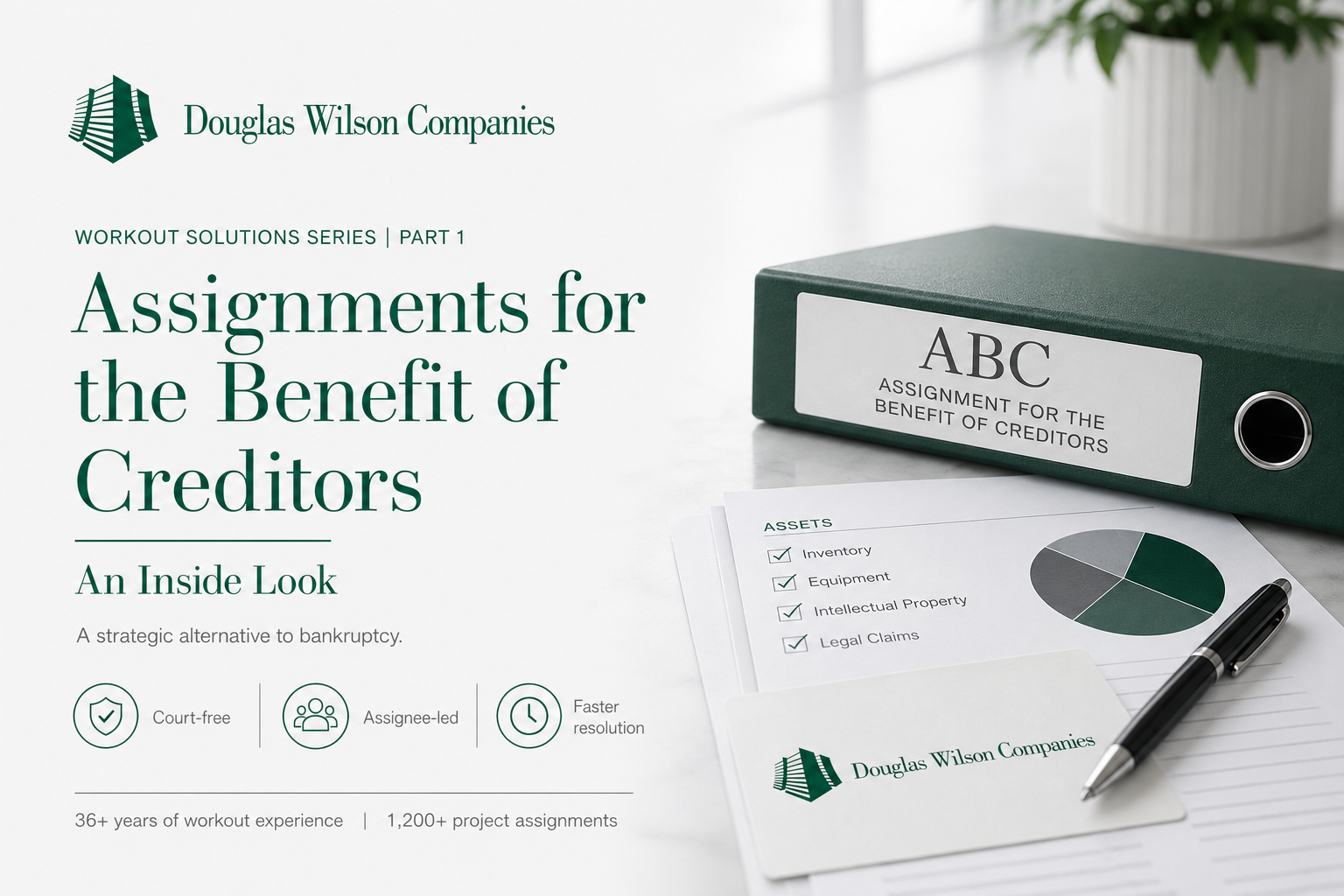
Alternative Workouts Part 1: All About ABCs and The Liquidation of Zulily

Many people relate the Douglas Wilson Companies name and legacy to real estate. But in reality, the organization’s 36 years of experience span more than 1,200 project assignments across a variety of sectors. Outside of real estate, the DWC team has managed workout scenarios for federal regulators, operating companies, industrial manufacturers, cannabis businesses, retailers, and many more.
In complex scenarios that need workout services, it’s important for these entities to remember that bankruptcy is not the only option. In fact, DWC has utilized many alternative paths forward for businesses, their leaders and creditors when they find themselves challenged financially or operationally, or if they are to the point of facing insolvency.
In the coming weeks, Douglas Wilson Companies will detail a number of these alternative solutions with examples and case studies from 36-plus years of experience providing specialized services for workout scenarios. From Chief Restructuring Officer to Receiver, Partition Referee and more, these roles make a critical difference for entities in distress and they can be significantly less costly than traditional bankruptcy proceedings.
In Part 1 of the series, we introduce the Assignment for the Benefit of Creditors, commonly known as an “ABC.” Read on to learn more about the recent example of former retail giant Zulily, where an ABC was used in the wind down of the company.
Assignments for the Benefit of Creditors: An Inside Look
An ABC is less common than a receivership, but offers many benefits and can be less costly than going through the bankruptcy process.
Simply defined, an ABC is a voluntary process during which a debtor agrees to have its assets liquidated without the intervention of a court. The process is conducted by an independent third party fiduciary chosen by the debtor. This fiduciary is called the “Assignee,” and is selected with creditor support in an effort to maximize the value of its assets — for the benefit of all known creditors.
What does the assignee do in an ABC?
The Assignee has powers similar to those of a trustee in a bankruptcy proceeding, though with some critical differences.
Generally, the Assignee in an ABC acts similarly to a Bankruptcy Trustee in its role to hold and transfer assets for the benefit of creditors.
When should an ABC be considered?
An ABC “can be the most advantageous and graceful exit strategy” for some distressed businesses, according to the American Bar Association.
ABA explains this may be especially true when the objective is to transfer the assets of the troubled business to an acquiring entity free of the unsecured debt incurred by the transferor. It may also be beneficial when there is a desire to minimize negative publicity and potential liability for stakeholders, in other words, to reduce headline risk.
What makes an ABC unique?
Lack of court involvement. This tends to minimize publicity and can reduce the headline risk that is often brought by public court filings.
Assignee selection. This process is conducted firsthand by the debtor. This means the Assignee may bring specific experience to the workout scenario, whether that is previous ABC work or expertise in a particular business sector or asset type. There are some distinctions:
- Assignees under the Commercial Code have the rights of a lien creditor, meaning the Assignees will take priority over unperfected creditors if they exist.
- Despite the lack of court involvement, there are several legal protections for Assignees, including avoidance actions that provide Assignees the power to avoid preferences as well as the ability to avoid fraudulent transfers.
- Assignees typically bear more risk than that faced by Bankruptcy Trustees or Receivers as there are fewer protections in place due to the lack of court oversight.
Timing. The lack of a court process also tends to mean a more timely completion of the assignment versus a bankruptcy proceeding. This can expedite the wind-down process.
ABC Case Study: The Wind Down of Zulily
An Assignment for the Benefit of Creditors was utilized as the mechanism for winding down former online retail giant Zulily, which declared it was insolvent in December 2023. DWC created a special purpose entity to serve as the Assignee.
Once valued at $4 billion, Zulily ABC was an e-commerce company headquartered in Seattle, WA. The company had two 700,000+ square foot warehouses located in Nevada and Ohio that held over 1.6 million in total units of product and extensive conveyor and racking inventory systems.
Zulily’s assets spanned four categories in total — physical inventory, mechanical assets, intellectual property and an antitrust lawsuit.
DWC and the assignment team identified a number of steps to a successful resolution:
- Assess corporate structure and identify key leaders
- Assess assets
- Build a team, including legal resources that can both support ABC structural needs as well as insolvency needs.
- Address tax issues, which may mean payroll, sales, federal and state
- Identify key service providers
Within a 3.5 month period, DWC was able to successfully liquidate all physical inventory. DWC was also able to create a bidding war for the intellectual property assets, which resulted in a recovery of nine times the originally estimated value. Lastly, DWC worked with the relevant landlords to obtain mutually beneficial agreements allowing the liquidation to be carried out in an orderly fashion maximizing the recovery for the estate. On the other side of the equation, DWC was able to collect, organize and notify nearly 600,000 creditors of the estate within a 30-day period.
Considerations for utilizing an ABC
Like all problem resolution, an ABC is not for every scenario. Entities in distress should ask questions to consider whether an ABC will be advantageous for liquidation and recovery. These might include:
- Is there potential headline risk? If so, an ABC may be favorable.
- Is there working capital available? This may be needed to fund the Assignee’s operational costs, cover due diligence and any fees associated with liquidation.
- What are the asset types? Where are they located? If assets are widespread across multiple states, the Assignee may need to register the ABC entity in each of the states.
- What is the value of the assets?
- Who controls movement of funds within the distressed entity?
Working with professionals experienced in the ABC process, such as DWC’s leadership team, is a good first step to exploring the potential use of an ABC.
*This article contains content from a previously published article in CRF’s Receivership News that was co-authored by DWC’s leadership. Read the original article, “ABCs 101: An Inside Look at Assignments for the Benefit of Creditors.”